

It often arises during the Comparing Paths phase. A family is sitting around the kitchen table reviewing their growing list of four-year colleges when someone raises a different possibility. “What if he did an apprenticeship in electrical work instead?” or “There is a two-year HVAC program at the local technical college that several people have recommended.” The suggestion sits in the room for a moment. It represents a path where the student would earn money while learning a skilled trade rather than paying to attend college full time. For some families the idea feels practical and grounded. For others it feels like stepping off the expected path they had been imagining for years. The conversation does not always resolve in that moment, but the possibility has now entered the discussion and refuses to leave quietly.
These earn-while-you-learn routes are not new ideas. They have existed for generations in various forms. Yet they frequently receive less sustained attention once the traditional four-year college search gains momentum. Families often default to the familiar college application process because it feels like the main road. This post explores two major categories within the earn-while-you-learn space: apprenticeships and trade or vocational schools. The focus is on their structural characteristics, particularly the earn-while-you-learn model, faster time-to-credential, income during training, and the important trade-offs between specialization and portability.
The goal is not to argue that these paths are better or worse than traditional four-year programs. It is to help families see them more clearly as legitimate options during the Comparing Paths phase so they can make decisions with greater structural awareness.
The Structural Role of Earn-While-You-Learn Paths in Comparing Paths
In the Comparing Paths phase, families are attempting to weigh different routes against one another. They consider factors such as total cost, time to completion, risk, flexibility, signaling power, and long-term earning potential. Traditional four-year programs typically require paying upfront (through savings, loans, or family support) for education with the expectation of higher earnings and broader opportunities years later. Earn-while-you-learn models reverse much of this sequence. The student begins earning income while developing specialized skills, often resulting in lower or even negative net cost during the training period itself.
These paths do not have to mean rejecting college entirely. Many families use them as primary routes, as stepping stones, as parallel experiments, or as ways to reduce early financial pressure while keeping other options open. What matters structurally is how deliberately the family evaluates the amount of early constraint each path creates and how much flexibility it preserves for future adjustments. Some paths lock in specialization quickly. Others preserve more reversibility in the early years. Understanding these differences helps families compare options with clearer eyes.
Apprenticeships: Union vs Non-Union
Apprenticeships combine paid on-the-job training with classroom instruction. Programs typically last one to five years and are sponsored by employers, unions, or industry groups. A student works full time under supervision while attending classes part time, often one or two nights a week. This model allows the apprentice to earn money from the very beginning while building deep practical skills.
Union-Sponsored Apprenticeships
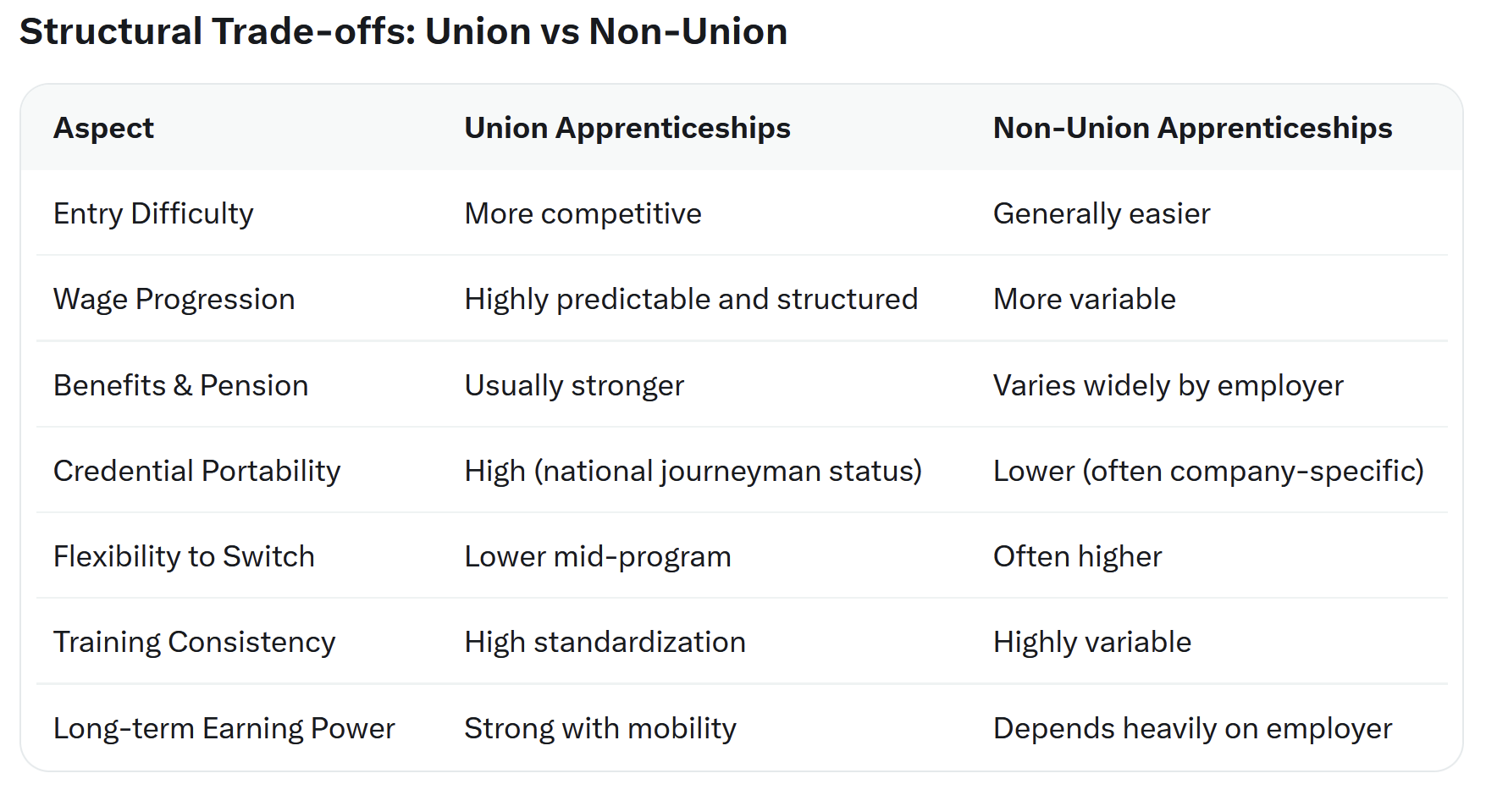
These are joint programs run collaboratively by labor unions and employers. Examples include the International Brotherhood of Electrical Workers (IBEW) for electricians, the United Association (UA) for plumbers and pipefitters, and various building trades councils. These programs are highly structured. They follow standardized curricula approved by the Department of Labor. Wage increases occur on a predictable schedule, often every six to twelve months. Benefits such as health insurance and pension contributions are usually strong. Upon completion, apprentices earn nationally recognized journeyman credentials that are portable across most states.
Entry is competitive. Candidates typically submit applications, take aptitude tests, and go through interviews. Once accepted, the program provides significant support including mentoring, tutoring, and job placement. Completion rates tend to be higher than many other training models because both the union and the employer have a direct stake in the apprentice’s success.
Non-Union Apprenticeships
These are sponsored directly by individual employers, industry associations, or private training providers. They are often easier and faster to enter. Pay and benefits vary more widely depending on the employer. Some companies offer excellent training and competitive wages from the start. Others provide minimal classroom instruction and function more like paid entry-level work with on-the-job learning. Credentials may be company-specific and less portable. Flexibility to switch employers mid-program is sometimes higher, but long-term security, standardization, and benefits can be lower.
Questions to Ask When Considering Apprenticeships
How important is national portability and standardized credentials versus faster entry?
How much structure and predictability does the student need to succeed?
How does the family value strong benefits and pension plans versus potentially higher starting pay in some non-union programs?
Is the student prepared for the competitive application process in union programs?
Action Steps Many Families Find Useful
Research both union and non-union programs in the specific trades the student is considering.
Compare wage progression schedules, benefit packages, and completion rates side by side.
Attend information sessions or speak with current apprentices and recent graduates from both types of programs.
Calculate projected earnings during the apprenticeship versus projected net cost of a traditional degree path.
Trade Schools and Vocational Programs
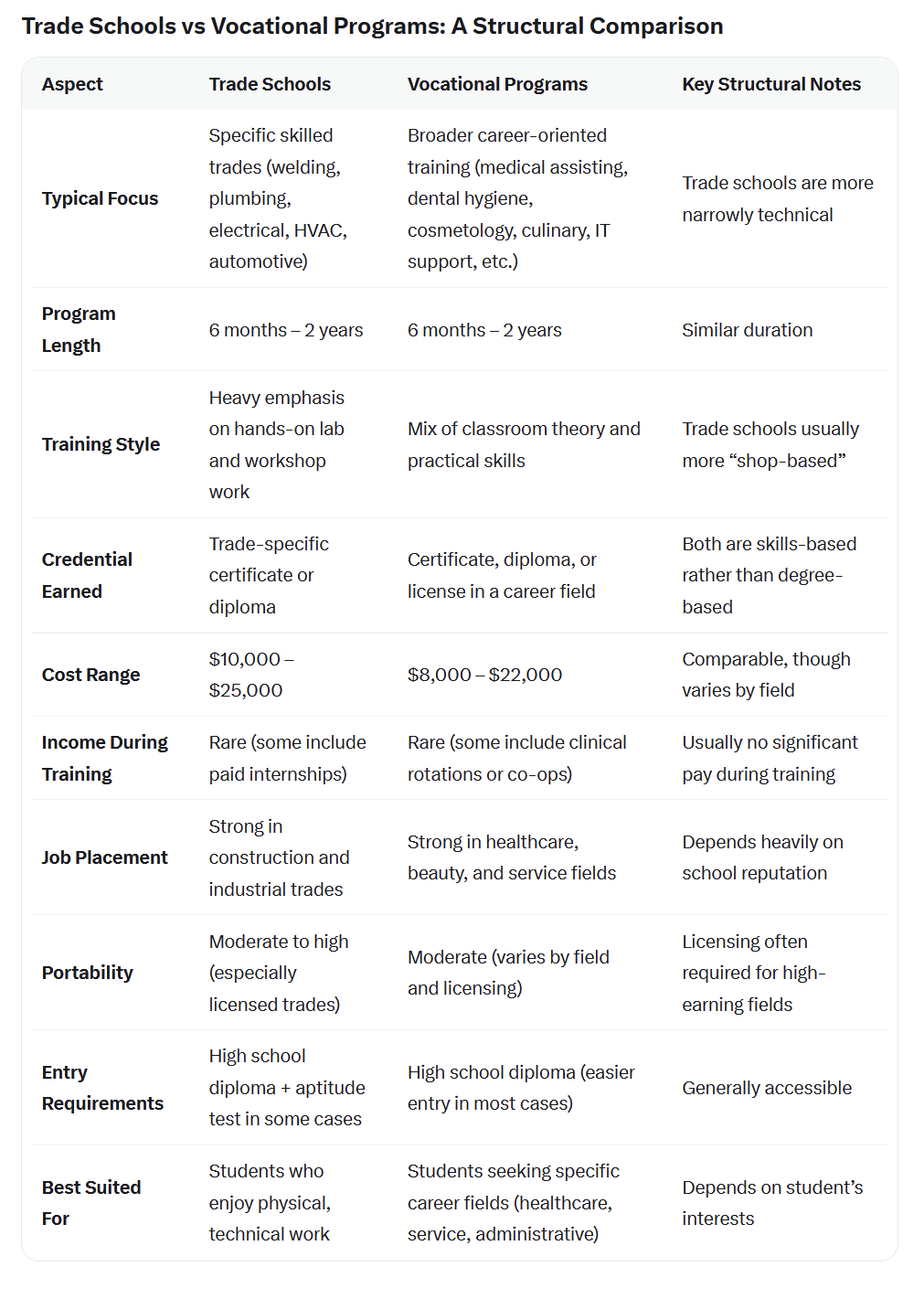
Trade schools and vocational programs typically offer certificates or diplomas in programs lasting six months to two years. These programs focus on developing specific, job-ready technical skills rather than broad general education. Common fields include automotive technology, welding, plumbing, HVAC, electrical work, dental hygiene, medical assisting, cosmetology, culinary arts, heavy equipment operation, and various allied health professions.
A student interested in welding, for example, might enroll in an 18-month program at a local technical college. Tuition could range from $16,000 to $22,000, depending on the school and whether the student qualifies for any grants or scholarships. She attends full time, often five days a week, spending long hours in well-equipped labs practicing different welding techniques on various metals. The program includes both hands-on training and some classroom instruction on safety standards, blueprint reading, and metallurgy. By the end, she earns several industry-recognized certifications that many employers require.
Many graduates from such programs enter the workforce earning between $45,000 and $65,000 in their first year, with experienced welders in high-demand specialties often reaching $70,000 or more within a few years. However, unlike apprenticeships, students in most trade school programs do not earn significant income during the training period itself. They are investing time and money upfront with the expectation of quicker entry into paid employment afterward.
Some programs improve this equation by incorporating paid internships or co-op placements. A dental hygiene student, for instance, might spend part of her training working in an actual dental office, earning a modest hourly wage while gaining real clinical experience. A culinary arts student might complete externships at local restaurants, earning income and building a professional network simultaneously. These paid components can reduce the net financial burden and provide valuable feedback about whether the student enjoys the day-to-day reality of the work.
Structurally, trade and vocational programs offer several distinct advantages. They provide relatively fast time-to-credential, allowing students to test a specific career field and enter the job market within one to two years rather than four or more. The training is highly focused and practical, emphasizing skills that employers need immediately. Many programs maintain strong connections with local industries, which can improve job placement rates for graduates.
At the same time, these programs come with their own structural trade-offs. Because students usually pay tuition upfront (or take loans), there is meaningful early financial constraint. Quality varies significantly between institutions. Some trade schools deliver excellent, up-to-date training with strong employment outcomes, while others have weaker instruction, outdated equipment, or inflated job placement claims. Unlike union apprenticeships, the credentials earned are not always nationally standardized or portable, which can limit mobility if the student later wants to relocate or change employers.
Questions to Ask When Considering Trade Schools and Vocational Programs
How quickly does the student want or need to enter paid work?
How important is classroom structure and theoretical learning versus pure on-the-job training?
What is the family’s tolerance for upfront tuition costs and potential loans?
How reliable are the school’s job placement rates and graduate earnings data for the specific program?
Would the student benefit from paid internships or co-op opportunities during training?
Action Steps Many Families Find Useful
Research completion rates, job placement statistics, and starting salary data for the specific programs the student is considering.
Visit the school in person if possible and sit in on classes or labs to observe the training environment.
Speak with recent graduates about their actual experience transitioning to work and any unexpected challenges they faced.
Calculate the total cost of the program, including opportunity cost of not earning income during training, and compare it directly with other paths under consideration.
Trade and vocational programs can be excellent options for students who have relatively clear career interests and prefer hands-on learning. They offer a faster route to skilled employment than traditional college in many fields, but they require careful evaluation of program quality and realistic assessment of long-term career prospects.
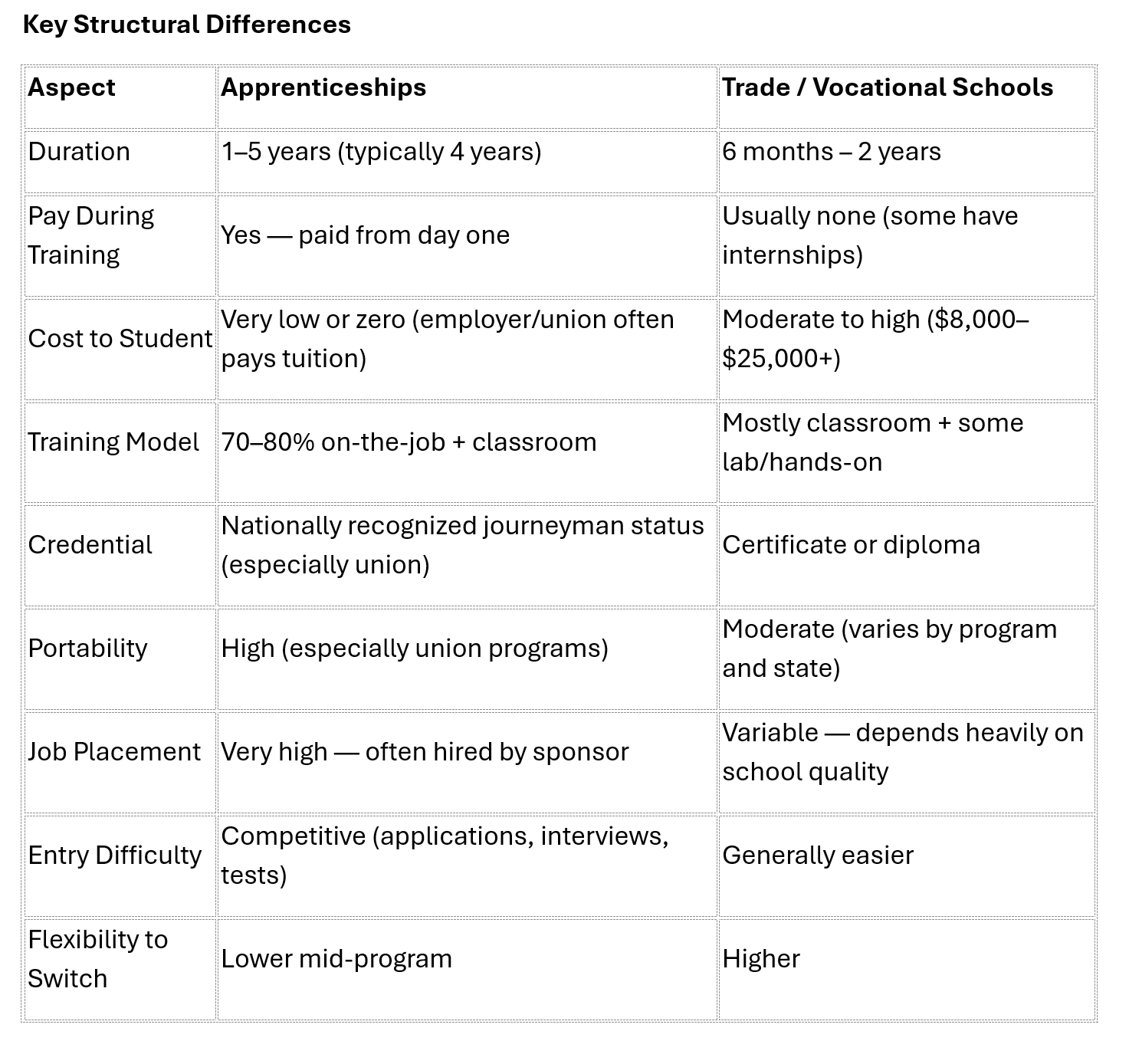
Apprenticeships vs Trade Schools: A Structural Comparison
While both fall under earn-while-you-learn or skills-focused routes, apprenticeships and trade schools differ meaningfully in structure.
Apprenticeships generally provide income from day one, highly practical training, strong job placement (especially in union programs), and better long-term benefits. They often lead to nationally recognized credentials but can have more competitive entry and longer total duration.
Trade Schools usually allow faster completion, more program variety, and easier entry. They tend to require paying tuition upfront with no or limited income during training, and outcomes can vary more widely depending on the quality of the specific school.
Key Structural Trade-offs
Income During Training: Strong advantage for apprenticeships.
Speed to Credential: Advantage for trade schools.
Upfront Financial Risk: Much lower in apprenticeships.
Portability and Standardization: Generally stronger in union apprenticeships.
Flexibility to Switch: Often higher in trade schools.
Broader Structural Trade-offs in Earn-While-You-Learn Models
When comparing these paths to traditional four-year routes, several recurring variables stand out.
Income During Training
Apprenticeships (especially union programs) allow students to earn money while learning. This can dramatically reduce or even eliminate net educational cost in the early years and reduce reliance on loans or savings.
Faster Time-to-Credential
Trade schools and some vocational programs move students into paid work more quickly than traditional degrees.
Specialization vs. Portability
Both paths create deep, job-ready skills. Apprenticeships (particularly union ones) often provide stronger national portability, while some trade school credentials are more regionally or employer-specific.
Reversibility and Constraint
Earn-while-you-learn paths tend to create lower early financial constraint. However, once a student gains specialized skills and begins earning a good wage, momentum to stay in that path can become strong. Social and identity constraints can also form around being “a tradesperson.”
Questions to Ask During Comparison
How important is immediate income versus faster credentialing?
How much early financial constraint is the family willing and able to accept?
How clear is the student’s interest in a specific trade?
How much value does the family place on national portability versus regional opportunities?
What is the student’s tolerance for competitive entry processes versus quicker admission?
Action Steps Many Families Find Useful
Create a simple side-by-side comparison spreadsheet of total projected costs, earnings during training, and expected starting salaries for each option.
Talk with people currently working in the trades the student is considering.
Visit training facilities and speak with instructors and recent graduates.
Use the Decision Map to locate where each option fits within the broader decision process and what phase the family is actually in.
Psychological Barriers: Earn While You Learn Paths Versus Traditional College
It often appears during the Comparing Paths phase. A family is weighing options when someone suggests an earn-while-you-learn route. “What if he did an apprenticeship or went to trade school?” The suggestion can create a noticeable pause. Even when the numbers look favorable on paper, something in the conversation shifts. The idea meets resistance that is rarely about finances or job prospects alone. It touches deeper feelings about identity, status, success, and what a “good” future is supposed to look like.
These psychological barriers are real and powerful. They deserve careful attention because they often exert more influence on the final decision than structural analysis alone.
The Deep Pull of the Traditional College Narrative
For many families, the image of a traditional four-year college experience carries strong emotional weight. It represents achievement, independence, social status, and a clear rite of passage. Years of cultural messaging, media portrayals, and family stories reinforce this narrative. Going to college is not just an educational choice. It is often experienced as the expected, respectable, and “smart” path.
When an earn-while-you-learn option is introduced, it can feel like a departure from this story. Even when the practical advantages are clear, families may experience an instinctive hesitation. This hesitation is rarely articulated as “I care about prestige.” It usually appears as vague concern: “Will this limit his future?” or “What will people think?” These feelings are powerful because they are tied to identity, parental pride, and long-held assumptions about success.
Common Psychological Barriers
Status and Social Perception
Traditional college carries strong signaling value in many social circles. Families may worry that choosing a trade school or apprenticeship will lead to judgment from relatives, friends, or neighbors. Parents sometimes fear being seen as having “settled” for their child. Students may worry about explaining their choice to peers who are heading to four-year schools.Identity and Self-Worth
Many students and parents have internalized the idea that a four-year college degree is central to personal identity and worth. Choosing a shorter or skills-based path can feel like admitting limitation or lowering expectations. A student might think, “If I don’t go to a regular college, does that mean I’m not smart enough?” A parent might feel, “After all we’ve invested, is this the best we can do?”Fear of Limiting Future Options
There is often a deep fear that choosing a specialized trade path will close doors permanently. Families worry the student will be “stuck” in that field with fewer opportunities for advancement or career changes. This fear persists even when data shows strong earning potential and mobility in many trades.Parental Anxiety and Social Comparison
Parents frequently compare their child’s path to those of peers or siblings. “All her friends are going to four-year colleges” can create significant emotional pressure. There is also the quiet fear of regret: “What if we steer him toward a trade and he later wishes he had the full college experience?”The Myth of the College Experience
The idea of the “full college experience” - dorm life, parties, sports, clubs, and broad exploration holds strong emotional appeal for many families. It is often seen as an essential rite of passage and a key part of becoming an independent adult. This narrative is reinforced by years of cultural messaging, media, and family stories.Earn-while-you-learn paths can feel like they deprive the student of this formative period. An apprenticeship or trade school program may mean living at home longer, working full time, and following a more structured schedule. This can create emotional resistance, even when the practical advantages are clear.
Recognizing this myth does not mean rejecting the traditional college experience. It simply invites families to examine whether the emotional pull is outweighing a clear assessment of the student’s actual needs and goals. The Decision Map can help hold both the emotional appeal and the structural realities in view.
Recognizing These Barriers When They Appear
If you are currently in the Comparing Paths phase, notice when these psychological barriers arise. They often show up as vague discomfort, quick dismissal of shorter paths, or repeated emphasis on “keeping options open.” These feelings deserve attention rather than suppression.
You might gently ask yourself:
How much of our hesitation is driven by social perception rather than the student’s actual interests and strengths?
Are we assuming a four-year degree is necessary for dignity or success?
How does fear of judgment or regret influence our evaluation of different routes?
What would change if we gave earn-while-you-learn paths the same serious consideration as traditional college?
These questions do not require immediate answers. They simply help bring the psychological layer into conscious awareness alongside the structural analysis.
Using the Decision Map to Navigate These Barriers
The Decision Map is especially useful here. When psychological barriers feel strong, returning to the map can help families locate where they are in the process. It reminds them that they are in the Comparing Paths phase and that emotional reactions to different routes are normal and worth examining. The map does not tell families which path to choose. It helps them see the decision more clearly, including the invisible psychological forces at play.
Many families find it helpful to discuss these barriers openly using the language of the four phases. This can reduce shame and create space for more balanced consideration of all options.
Recognizing These Options During Comparison
If you are currently in the Comparing Paths phase, notice whether earn-while-you-learn routes are receiving deliberate consideration or being quietly filtered out by early assumptions. Some families automatically prioritize traditional four-year residential experiences without ever exploring the structural characteristics of shorter or skills-focused routes. Others give them token attention but do not treat them as serious alternatives.
A gentle practice is to deliberately include at least one earn-while-you-learn option in the comparison process. This does not mean the family must choose it. It simply widens the field of possibility and makes the structural trade-offs more visible. The Decision Map can serve as a helpful reference here, reminding families to examine not only which path feels right in the moment, but how much early constraint each path creates and how much flexibility it preserves.
Looking Ahead
Earn-while-you-learn models represent an important part of the Comparing Paths phase. They offer families additional ways to balance immediate income and skill development with longer-term goals. Future posts will continue exploring this phase, including gap years and direct workforce entry.
For now, the invitation is simple. When comparing paths, give earn-while-learn options deliberate attention. Notice the structural characteristics each one brings, particularly around income during training, speed to credential, and the balance between specialization and portability. This awareness does not replace the feeling of fit. It simply keeps the full structural picture in view while comparison is still active.
The four-phase map remains a steady reference point. Return to it whenever earn-while-you-learn paths deserve more consideration or when the comparison process feels unbalanced. The phases are here to help you see the decision more clearly.
The archive will continue building the Comparing Paths section with additional perspectives on how families weigh different routes. Each piece aims to strengthen structural clarity rather than prescribe specific choices.
College: Is It Worth It is published by ProfSpirit LLC.